
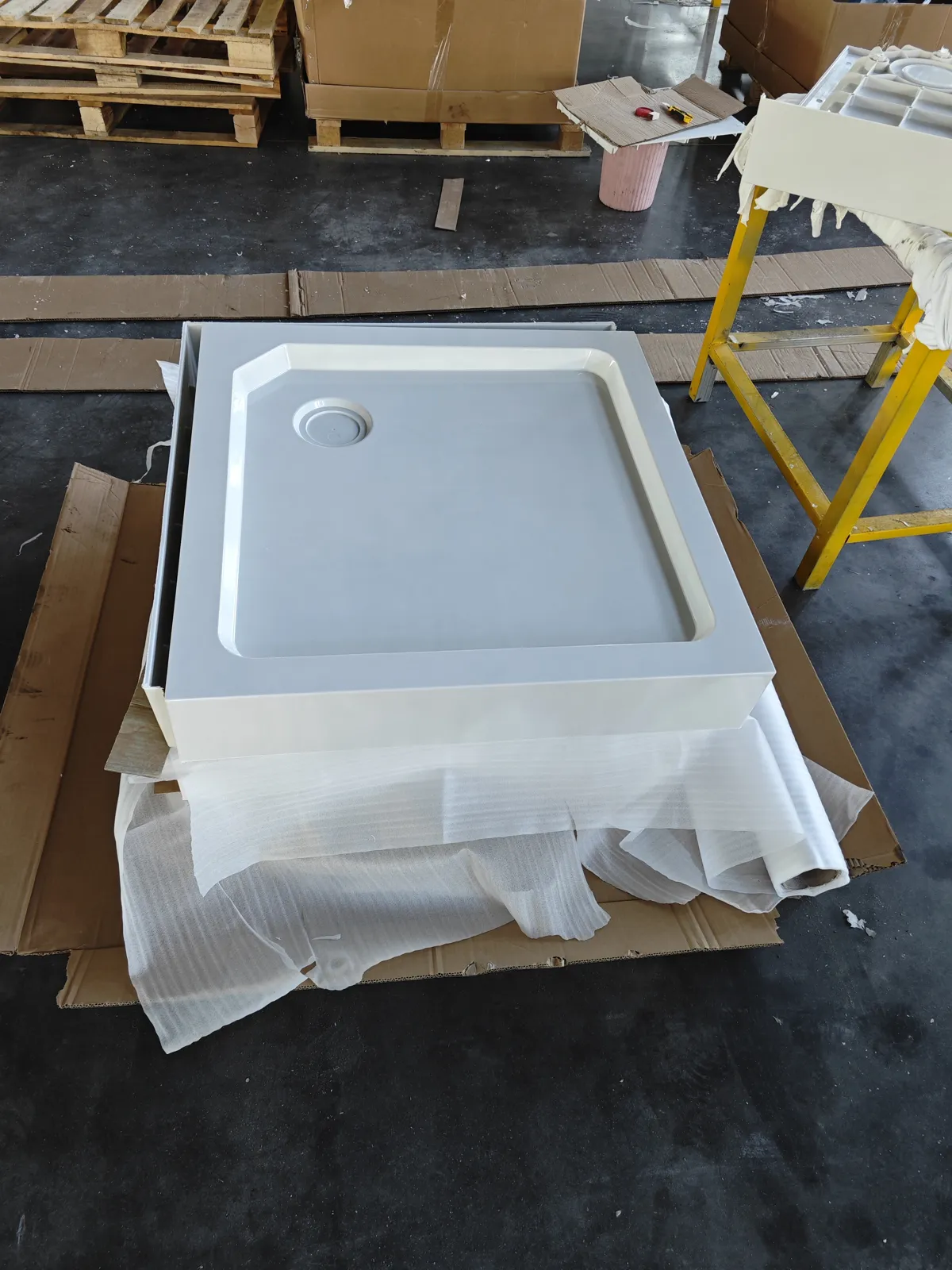
No, they are not the same — but if a listing called an SMC pan “molded fiberglass,” you were not imagining things. SMC is glass fibre set in resin, pressed in a closed steel mould; a traditional fiberglass pan is glass fibre and resin laid up or sprayed in an open mould. The pressed part comes out identical every cycle — our Serie L reference pan is 26 mm in profile and 13.6 kg at 1200 × 800 mm (L-12080) — while a laid-up part’s thickness and stiffness depend on the hands that made it. This page compares the two processes honestly, including the places where fiberglass construction is perfectly serviceable and the one place SMC is worse: deep repair.
By the SMC Shower Engineering Team · Last updated: November 2026
Why do people call SMC pans “fiberglass”?
Because the word is doing three jobs at once. Fiberglass names a fibre — glass fibre. It also names a traditional way of building with that fibre — open-mould lay-up. And in retail listings it is used as a loose label for almost any rigid composite pan, including pans that are in fact SMC. Well-known ranges have been sold for years under descriptions such as “molded fiberglass” where the underlying moulded material is SMC-type composite. The result is that a buyer comparing “fiberglass vs SMC” is sometimes comparing a label with a material, not two materials.
The practical fix is to ask what the pan is made from and how it is moulded, not what the listing headline calls it. Our SMC name decoder matches the retail names buyers actually meet — including the “molded fiberglass” wording — to the material behind them. And if the basic definition is still fuzzy, start with what an SMC shower pan is, then come back to this comparison.
How is each pan actually built?
In open-mould fiberglass construction, resin and chopped or matted glass fibre are applied into a one-sided mould — sprayed up or laid by hand — and cured at ambient conditions, often with a gel coat applied first to form the visible surface. It is a flexible, low-tooling-cost process, well suited to large one-piece tub-and-shower units and varied shapes. Its trade-off is process control: thickness, fibre distribution and cure are operator-dependent, so quality varies between makers and sometimes between batches.
SMC construction moves the control into the material and the tooling. The compound is manufactured first, as a sheet with a controlled fibre content, then a measured charge is compression-moulded between matched heated steel dies. Thickness is set by the mould, cure is driven by mould temperature and pressure, and the walking surface, slope, drain area and underside ribs are formed in the same cycle. The pan you receive is, in effect, a copy of a steel tool — which is why repeatability, not raw strength, is SMC’s deepest advantage for a volume buyer.
SMC vs fiberglass: the side-by-side table
| Point of comparison | SMC (Serie L reference) | Fiberglass (open-mould lay-up) |
|---|---|---|
| Process | Measured compound charge pressed in matched heated steel moulds | Resin and glass fibre sprayed or laid into an open mould, gel coat surface |
| Consistency | Thickness, weight and shape fixed by the tool; unit-to-unit variation is minimal | Depends on operator and maker; thickness and stiffness can vary across the part and between batches |
| Weight | 13.6 kg at 1200 × 800 mm (L-12080) | Varies with lay-up thickness and any supporting structure; ask for the measured weight of the exact model |
| Profile | 26 mm low profile; sizes 800–1800 × 700–900 mm across 30 models | Wide range, including one-piece tub/shower surrounds that SMC does not attempt |
| Surface | Texture moulded into the part itself; matte slate in white, grey, black, beige, brown; anti-slip Class C (DIN 51097) | Gel coat surface over the lay-up; a damaged gel coat exposes the laminate beneath |
| Structure | Surface and body are one material; nothing bonded to separate | Layered construction: gel coat, laminate, often additional support — layers can be a failure path if poorly made |
| Failure points | Deep impact chips; cracking over unsupported voids | Gel coat cracking and crazing, soft or thin areas, flex where support is uneven |
| Repair | Deep chips are difficult to repair invisibly — SMC’s honest weakness | Gel coat and laminate repairs are a long-established trade skill; surface repairs are widely available |
| Installation | One-person handling at 13.6 kg for the reference size; full, even support required | Handling depends on size and format; large one-piece units need more hands and access planning |
| Logistics | L-12080 packs at 0.055 CBM; 1,249 pieces in a 40HQ container | Ask for packed weight and volume per model; bulky one-piece formats ship inefficiently |
Which one should a distributor or project buyer choose?
Choose on the failure you can least afford. If you are supplying hundreds of bathrooms, your expensive failure is variability — a batch that feels different underfoot, slopes that wander, weights that change your freight maths. That is the failure a steel mould eliminates, and it is why SMC is specified for repeat-unit work. If you are buying a single large one-piece tub-and-shower unit for a residential remodel, fiberglass construction offers shapes and formats that a flat SMC pan is not trying to replace, and its repair trade is everywhere. Both statements can be true at once, because these are different tools for different jobs.
One more honest line in the other direction: established fiberglass ranges from established makers are consistent products with long track records, and a cheaply made SMC pan from an uncontrolled factory is still a cheap pan. Material names do not replace supplier verification — ask any maker, including us, for the specification sheet, the measured weight and the test documents for the exact model. Buyers also comparing cast and formed options will find the companion pages useful: SMC vs stone resin and SMC vs acrylic.
How can I tell the two apart in a warehouse?
You cannot always tell from the top face, which is exactly why the naming confusion survives — so turn the pan over and read the documents. A laid-up fiberglass pan usually shows its making on the underside: a rougher laminate texture, visible variation in thickness, and often a separate support structure. A pressed SMC pan shows a moulded underside with formed reinforcing ribs, even wall behaviour at the edges, and a surface texture that is part of the part rather than a coating on it. Then check the paperwork against the pan in front of you: a moulded range can state a measured weight per model — 13.6 kg for our 1200 × 800 mm L-12080 — a fixed profile, 26 mm across Serie L, and a drain drawing that the next hundred units will match. If the pan in the warehouse and the sheet in the office disagree, believe the pan and ask harder questions.
What does this mean for returns and claims?
Distributors feel the process difference again here. Gel coat complaints — crazing, surface cracks, thin spots — are a known category with fiberglass construction, and the established repair trade means many can be resolved without replacing the unit. SMC claims are rarer in kind but blunter in outcome: the pan is either sound, or it has taken damage that points to replacement, so your claims process becomes a logistics process — which is predictable, provided your order planning included spare units. Neither pattern is a verdict on the material; both are arguments for matching your stocking and spares policy to the construction you chose, and for briefing installers that correct, full support prevents the largest single category of claims for both.
Frequently asked questions
Is SMC a type of fiberglass?
SMC contains glass fibre, so it belongs to the wider glass-reinforced composite family. But in the shower pan market, “fiberglass” normally describes open-mould lay-up construction, and SMC describes a compound pressed in closed steel moulds. Same fibre family, different material form and different process — and the process is what decides consistency.
A listing says “molded fiberglass.” How do I know if it is SMC?
Ask the seller two questions: is the material supplied as a pre-made moulding compound sheet, and is the pan pressed between matched moulds? If both answers are yes, you are looking at SMC construction whatever the headline says. Our decoder page lists the common retail names and what sits behind each one.
Which lasts longer, SMC or fiberglass?
We do not publish service-life years for either material, because real life depends on installation quality and use, not on the label. What can be said from construction: SMC has no gel coat to craze and no layers to separate, while a well-made fiberglass pan with intact gel coat and full support has a long record in service. Correct bedding decides more than the brochure does.
Can a fiberglass pan be repaired more easily than an SMC pan?
Yes, for surface damage. Gel coat repair is a standard trade skill. A deep chip in an SMC pan is hard to make invisible, which is why we advise project buyers to hold spare units rather than plan on cosmetic repairs.
Buying pans in volume for distribution or a project? Request a quote.