
An SMC shower pan is a shower base compression-moulded in a heated steel mould from Sheet Moulding Compound — a sheet of polyester resin reinforced with glass fibre, formed under heat and high pressure into a single rigid piece. Our low-profile Serie L form is just 26 mm high, and a 1200 × 800 mm pan (model L-12080) weighs 13.6 kg, light enough for one installer to carry and position. The surface, structure and drain area come out of the mould as one part, with no separate gel coat to peel and no foam core to crush.
By the SMC Shower Engineering Team · Last updated: November 2026
What does SMC actually stand for?
SMC stands for Sheet Moulding Compound. Before moulding, the material exists as flat sheets: chopped glass fibres held in a resin paste, rolled out and stored like a heavy industrial fabric. To make a shower pan, a measured charge of that sheet is placed into a matched steel mould, the mould closes under high pressure, and heat cures the resin while the material flows into every rib, slope and edge of the cavity. When the mould opens, the pan is finished in shape — the walking surface, the fall toward the drain, the upstands and the reinforcing ribs underneath are all one moulded part.
This is why buyers who handle one for the first time often describe it as feeling closer to a moulded automotive panel than to a bathroom fitting. That comparison is fair: the same family of compression-moulded composite is used for vehicle body panels and electrical enclosures, applications chosen because the parts must hold their shape, resist impact and stay consistent across long production runs. A shower pan made this way does not depend on a surface coating for its strength. The strength is in the part itself, all the way through its thickness.
What is an SMC shower pan made of, layer by layer?
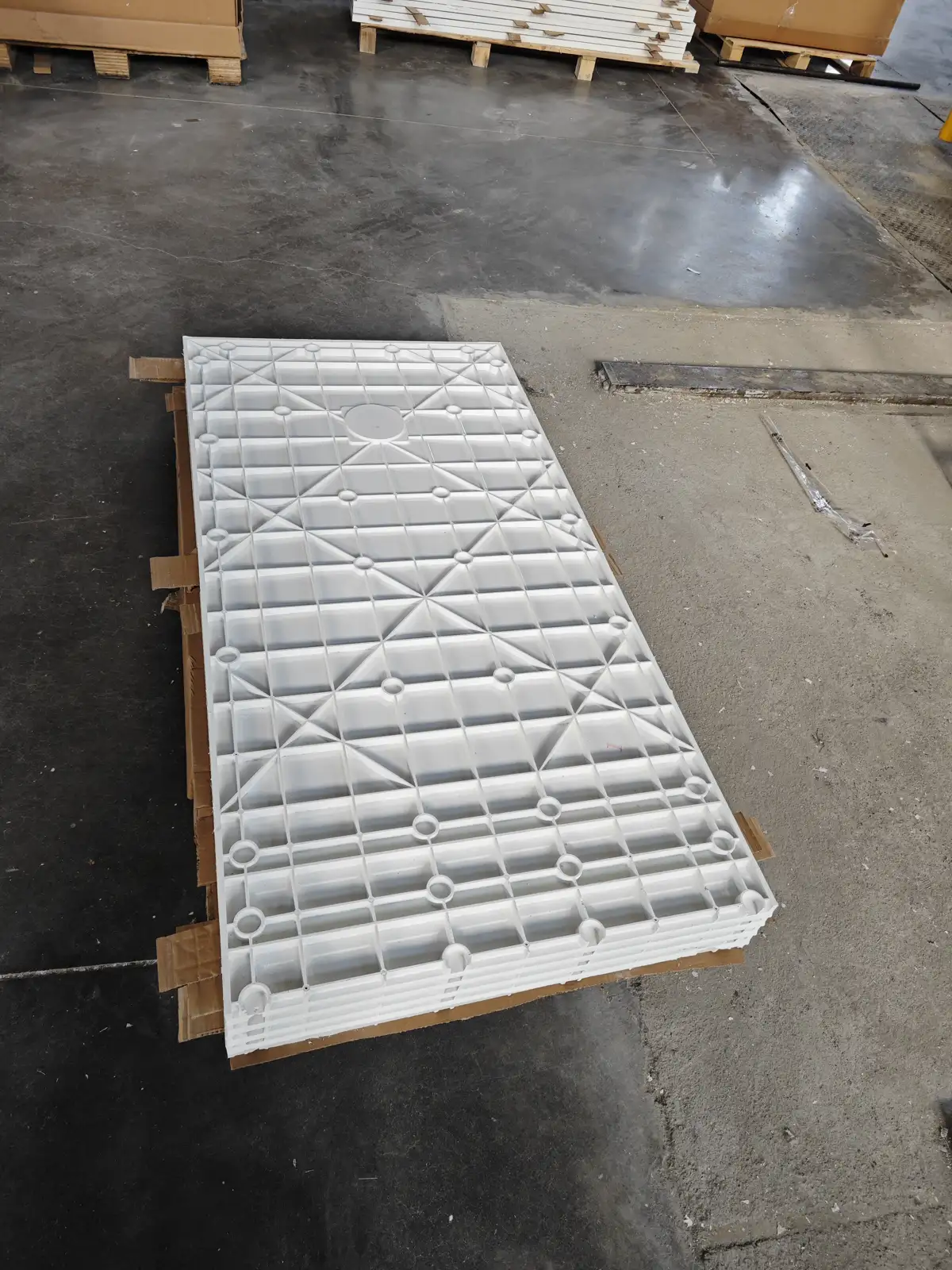
Cut an SMC pan open and you will not find layers in the way you would in a laminated product. There is no separate skin glued over a different core. The cross-section is a single composite: glass fibres distributed through cured resin from the walking surface to the underside. The visible top surface is a matte, slate-textured finish moulded directly into the part — on Serie L it is offered in white, grey, black, beige and brown — and the underside carries moulded reinforcing ribs that stiffen the floor of the pan between its support points.
Two practical consequences follow from that single-piece construction. First, a surface scratch does not expose a different material underneath, because there is no different material underneath. Second, the pan cannot delaminate, because there are no bonded layers to separate. When you read specifications, this is the honest meaning behind the description “glass fibre reinforced SMC” used for Serie L: the reinforcement is inside the compound itself, not applied afterwards.
How big are SMC shower pans, and how much do they weigh?
Size ranges depend on the series. Serie L, the low-profile range, covers 30 models from 800 to 1800 mm long and 700 to 900 mm wide, all at a 26 mm profile — lengths include 900, 1000, 1100, 1200, 1300 and 1400 mm in the model list (L-9070, L-10070, L-11070, L-12070, L-13070, L-14070 and more). Serie K is the inch-based range with a 4-inch profile, textured surfaces and alternative drain positions for North American layouts. Other series cover different profiles: Serie U at 40 mm and the TS high-profile range at 140 mm for quadrant and square formats where a raised pan is needed.
On weight, the reference point we publish is measured, not estimated: the Serie L model L-12080, at 1200 × 800 mm, weighs 13.6 kg. That matters on site and in the warehouse. One person can move it without a second pair of hands, it stacks flat for transport, and its packed volume is 0.055 CBM, which is why a 40HQ container loads 1,249 pieces of this model. If you are comparing materials, keep that 13.6 kg figure in mind and ask every supplier for the equivalent measured weight of the exact model you are buying — weight is one of the fastest ways to expose a vague specification.
| Serie L at a glance | Figure |
|---|---|
| Material | Glass fibre reinforced SMC, compression moulded in one piece |
| Profile height | 26 mm |
| Size range | 800–1800 mm long × 700–900 mm wide, 30 models |
| Reference weight (L-12080, 1200 × 800 mm) | 13.6 kg |
| Packed volume (L-12080) | 0.055 CBM |
| Finishes | White, grey, black, beige, brown; matte slate surface, square drain cover |
| Anti-slip rating | Class C (DIN 51097), the highest class under that barefoot test method |
Is an SMC shower pan the same as a fiberglass pan?
No — but the confusion is understandable, and it is not really the buyer’s fault. SMC contains glass fibre, so sellers, marketplaces and even some manufacturers describe SMC pans with the word “fiberglass.” A traditional fiberglass pan is built differently: resin and glass fibre are laid up or sprayed into an open mould, usually over a supporting structure, and the part’s stiffness depends heavily on how that lay-up was done. An SMC pan is pressed in a closed steel mould from a pre-made compound sheet, which is why two pans from the same mould come out effectively identical in thickness, weight and shape.
The market makes this harder by selling the same SMC material under retail names that give no hint of what the pan actually is. If you have seen names such as Transtone or “solid surface” on a listing and wondered what you were really looking at, our SMC name decoder matches the common retail names to the material behind them. And if your real question is which of the two you should specify, the side-by-side in SMC vs fiberglass lays out the practical differences without the sales language.
How does an SMC pan compare with stone resin and acrylic?
Stone resin pans are cast from a resin-and-mineral mixture and are noticeably heavier to handle in the same size; they suit buyers who want a cast, stone-like feel and have the handling and floor structure planned around that weight. Acrylic pans are thermoformed from sheet, usually over a reinforcing backing, and are light, but their surface and support behaviour are different from a moulded composite. SMC sits between those two reference points: rigid and one-piece like a cast product, but at a handling weight closer to a formed product. The full side-by-side figures and the honest trade-offs are in SMC vs stone resin; in short, choose on weight, repairability and how the pan is supported, not on the material name alone.
What should I check before I specify an SMC pan?
- Profile and threshold. A 26 mm low profile gives a near-flush entry, but confirm the finished floor build-up with your installer before ordering.
- Drain position. Measure from the stud, not from finished wall surfaces, and match the drawing of the exact model — Serie K offers alternative drain positions for inch-based layouts.
- Support. An SMC pan still needs the full, even support its installation instructions describe; rigidity is not a licence to bridge gaps. Our SMC shower pan installation guide walks through bedding and support in detail.
- Cutting. Serie L offers cut-to-fit options, but only as permitted by the selected model’s installation instructions — confirm before you plan a trimmed size.
- Documents. Ask for the specification sheet for the exact model, and check that any certification claimed is one you can verify; our pans carry CE marking, production under an ISO 9001 quality system, and the Class C (DIN 51097) anti-slip rating stated above.
Frequently asked questions
What is an SMC shower base?
It is the same product as an SMC shower pan — “base” and “pan” are used interchangeably in North America. It is a shower floor compression-moulded in one piece from Sheet Moulding Compound, a glass-fibre reinforced resin material, with the slope, surface texture and drain area formed in the mould.
Is SMC a plastic?
SMC is a fibre-reinforced composite, not a plain plastic. The resin matrix is a thermoset polyester, and the glass fibre inside it carries the load. Once cured under heat and pressure it cannot be melted back down and re-formed the way a thermoplastic sheet can, which is part of why it holds its shape in a hot, wet bathroom.
How thick is an SMC shower pan?
Thickness and profile are different things. The profile — the visible height of the pan — is 26 mm on Serie L, 40 mm on Serie U and 140 mm on the TS high-profile range, while Serie K has a 4-inch profile. The material thickness of the moulded shell is carried in the model’s specification sheet; ask for that sheet for the exact model you are specifying.
Can an SMC shower pan be cut to fit?
Serie L offers cut-to-fit options, but cutting is only permitted as described in the selected model’s installation instructions. Confirm the permitted edges and the resulting drain position before ordering a pan you intend to trim.
Does an SMC pan need a mortar bed?
It needs the full, even support described in its installation instructions, which for most installations means a properly prepared bedding layer so no area of the floor can flex under load. The exact method for each series is covered in our installation guide, linked above.
Buying pans in volume for distribution or a project? Request a quote.